Author: Chef Wendell White
Category: Culinary Fundamentals / Sensory Execution
Quick Summary
Knowing when food is done isn’t about memorizing cooking times. Professional cooks learn to recognize physical changes in food through sight, sound, smell, and touch. Browning deepens, sizzling changes as moisture evaporates, aromas develop, and proteins become firmer as they cook.
These sensory cues tell you when it’s time to check the food, while an instant-read thermometer provides confirmation when temperature and food safety matter.
The timer tells you when to look. The food tells you what’s happening.
The Clock Is an Alarm, Not a Judge
Walk into a busy professional kitchen and you’ll hear timers going off everywhere.
But the timer isn’t deciding when the food is done.
It’s reminding the cook to look at the food.
That’s an important distinction.
A recipe may tell you to bake a chicken breast for 25 minutes, but that number was created using a particular oven, pan, cooking temperature, and size of chicken breast.
Your kitchen is different.
Is your chicken breast 6 ounces or 12 ounces?
Did it go into the pan refrigerator-cold?
Is your oven actually holding the temperature displayed on the dial?
Are you cooking on thin aluminum, stainless steel, or heavy cast iron?
All of those variables affect cooking time.
Recipes give us reference points. Food gives us evidence.
A timer should tell you when to start paying attention—not when to stop thinking.
And this is part of the same freedom I talk about in 🟨 INTERNAL LINK: [How to Build Flavor Without a Recipe: Simple System — Story #53]. The goal isn’t to abandon recipes. It’s to understand enough about cooking that you aren’t helpless without one.
Food Changes as It Cooks
Heat causes physical changes you can see, hear, smell, and feel.
Moisture evaporates.
Proteins tighten.
Starches soften and gelatinize.
Sugars caramelize.
Surfaces brown.
Fat renders.
Aromas become stronger.
Once you understand those changes, cooking becomes less about watching a clock and more about recognizing where the food is in the cooking process.
Think of it as a progression:
RAW → COOKING → DONE → OVERCOOKED
Raw
Food is generally wetter, softer, paler, and less aromatic.
Raw proteins have very little resistance when pressed.
Cooking
Moisture begins escaping rapidly.
That’s one reason a wet piece of meat hitting a hot pan produces such an aggressive sizzle.
The exterior begins drying, proteins tighten, fats render, and browning develops.
Done
Now the clues become more subtle.
The violent sizzling becomes steadier.
Browning deepens.
The aroma becomes richer.
Proteins develop resistance and spring back when gently pressed.
Vegetables soften while developing caramelized edges.
Overcooked
Eventually the clues move in the opposite direction.
Moisture disappears.
Proteins become rigid.
Vegetables collapse.
A beautiful roasted aroma can turn bitter.
The food was telling you what was happening the entire time.
You just have to learn how to listen.
The 4-Sense Doneness Framework
When I’m cooking, I’m constantly reading four things:
Sight. Sound. Smell. Touch.
You don’t consciously run through a checklist every time you cook. Eventually these observations become instinct.
But instinct comes from repetition.
1. Sight: Watch the Food Change
Color is one of the easiest indicators.
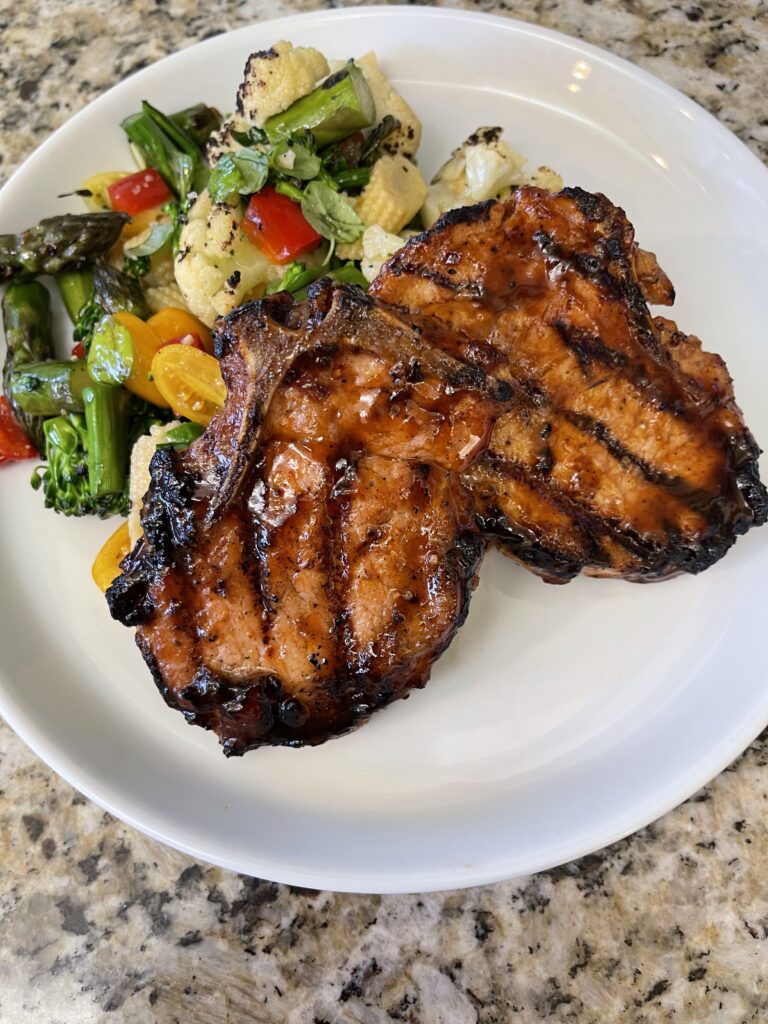
When searing or grilling meat, look at the development of the crust.
You’re looking for browning—not simply black grill marks.
Vegetables tell you something similar.
Cabbage hitting a hot grill begins to soften while its edges blister and caramelize. Asparagus becomes brighter before eventually losing structure if you continue cooking it too long.
You can also watch for:
- Browning around edges
- Surface moisture disappearing
- Fat rendering
- Meat shrinking slightly
- Bone becoming exposed as meat contracts
- Sauces becoming glossy as water evaporates
- Bubbles becoming slower and heavier as liquids reduce
Your eyes are constantly giving you information.
2. Sound: Listen to the Pan
This is one of the most overlooked cooking skills.
Drop a wet protein into a hot skillet and you’ll hear aggressive popping and sizzling.
That’s water rapidly turning into steam.
As surface moisture evaporates and browning develops, the sound changes.
The wild splattering begins settling into a tighter, steadier sizzle.
That change matters.
If the pan becomes extremely quiet, pay attention. You may be running out of moisture and moving toward drying or burning the food.
After enough time cooking professionally, you can hear something happening behind you and know that a pan needs attention.
That’s not magic.
It’s repetition.
3. Smell: Your Nose Is an Early-Warning System
Your nose will often tell you something is ready before you look at it.
Think about butter.
As butter heats, water evaporates and the milk solids begin browning.
Then suddenly you smell it.
Nutty.
Toasty.
Almost hazelnut-like.
That’s the moment.
Wait too long and that beautiful aroma turns bitter.
The same thing happens when roasting vegetables, searing meat, toasting spices, caramelizing onions, or grilling food.
Aromas become deeper and richer as browning develops.
When the smell suddenly changes, check the pan.
Professional cooks learn to react to those changes automatically.
And aroma isn’t separate from flavor. It’s one of the signals you learn to recognize when you’re developing the skills I discuss in 🟨 INTERNAL LINK: [How to Balance Flavors Like a Professional Chef — Story #56].
4. Touch: Learn Resistance
Touch is especially useful with proteins.
I’m not a fan of the old internet trick that compares steak doneness to different parts of your hand.
Everybody’s hands are different.
Learn the food instead.
Raw protein generally feels soft and offers very little resistance.
As proteins cook, their structure tightens.
A properly cooked piece of meat usually gives you some resistance while retaining spring.
Overcook it and that spring disappears.
It becomes increasingly rigid.
You aren’t trying to memorize what somebody else’s hand feels like.
You’re learning how your food changes under heat.
Different Foods Give Different Signals
The same sensory principles apply across the kitchen, but different foods communicate doneness differently.
Steak and Pork Chops
Press gently near the center.
As the protein cooks, resistance increases.
Rare beef will feel softer. Medium-rare develops more spring. As the meat moves toward well-done, it becomes increasingly firm.
Don’t repeatedly stab or squeeze the meat. You’re checking—not interrogating it.
Fish
Fish changes dramatically as its proteins cook.
Raw fish tends to look translucent and feel soft.
As it cooks, the flesh becomes increasingly opaque and begins separating naturally along its flakes.
Press gently.
If the center still feels excessively soft or raw, it needs more time. If the fish has become tight, dry, and leathery, you’ve gone too far.
Potatoes and Root Vegetables
Use a paring knife.
Insert the tip into the thickest part.
When a potato, carrot, beet, or similar vegetable is properly cooked, the knife should slide through easily without a hard center fighting back.
Pasta
Taste it.
That’s still one of the best tools you’ve got.
Properly cooked al dente pasta should offer slight resistance when bitten without having a hard, chalky center.
Don’t cook pasta according to the box and walk away.
Start tasting before the suggested cooking time ends.
Where the Thermometer Fits
Cooking without depending on a timer does not mean cooking without precision.
I use sensory cues to tell me when to check.
A thermometer tells me what the internal temperature actually is.
Those are two different jobs.
This becomes particularly important with poultry, ground meats, large roasts, reheated foods, and other situations where food safety matters.
Whole-muscle beef, lamb, veal, and pork are also different from ground products because grinding can move surface contamination throughout the meat.
That distinction matters.
A steak cut from an intact beef primal may be intentionally served rare or even blue depending on preparation, handling, local food-code requirements, and the customer’s preference.
Ground meat requires different consideration because bacteria that may have been on the exterior can become distributed throughout the product during grinding.
If you’re grinding meat yourself from properly handled whole-muscle cuts, you have greater control over that process—but control does not eliminate food-safety considerations.
Wild game requires additional attention because species, parasites, harvest conditions, processing, and regulatory recommendations can vary.
And freezing should never be treated as a universal substitute for proper cooking. Some parasites can be affected by validated freezing processes, but freezing does not reliably eliminate every foodborne hazard.
As a ServSafe-certified chef, I separate two questions:
Is the food at the doneness I want?
and
Is the food safe for the person I’m serving?
Those aren’t always the same question.
For specific safe minimum temperatures and handling requirements, follow current USDA/FDA guidance and applicable local food codes.
Sensory Skill and Temperature Work Together
This is where home cooks sometimes misunderstand professional cooking.
Using a thermometer doesn’t mean you don’t know how to cook.
Quite the opposite.
If I’ve spent money on a beautiful piece of meat, I’m not proving anything by guessing.
My senses tell me:
That crust looks right.
The pan sounds different.
I can smell the browning.
The protein feels close.
Then the thermometer gives me another piece of information.
The better cook isn’t the person who refuses to use tools.
The better cook understands what every tool is telling them.
And once you understand those physical cues, you begin making better decisions beyond doneness. You start understanding when food needs more acid, more salt, more richness, or simply more time—the same kind of judgment behind 🟨 INTERNAL LINK: [How to Fix Bland Food Fast Without Starting Over — Story #52].
Everything starts connecting.
That’s when you stop simply following recipes and start understanding cooking.
Eventually, You Know Before You Look
After more than 25 years in professional kitchens, there are things I react to without thinking about them anymore.
I can hear a pan change.
I can smell butter beginning to brown.
I can see how quickly bubbles are breaking in a sauce and know whether it needs another minute.
I can press a piece of meat and know I’m getting close.
That isn’t because I stopped using thermometers or timers.
It’s because I’ve cooked enough food to understand what those tools mean in combination with what my senses are telling me.
That’s the skill I want home cooks to develop.
Don’t throw away your timer.
Don’t throw away your thermometer.
Just stop surrendering your judgment to them.
Trust the Food
Recipes are useful.
Timers are useful.
Thermometers are useful.
But none of them replace awareness.
Start watching what happens when your food hits the pan.
Listen to the difference between wet sizzling and steady browning.
Notice when the aroma changes.
Touch the food and learn how its resistance develops.
Taste whenever tasting is safe and appropriate.
Do that often enough and something changes.
You stop asking:
“How many minutes does this cook?”
And start asking:
“What is the food telling me?”
That’s when you’re really learning how to cook.
The timer says 10 minutes. The food says it’s done. I trust the food every single time.
What food gives you the most trouble when judging doneness—steak, fish, poultry, vegetables, or something else?